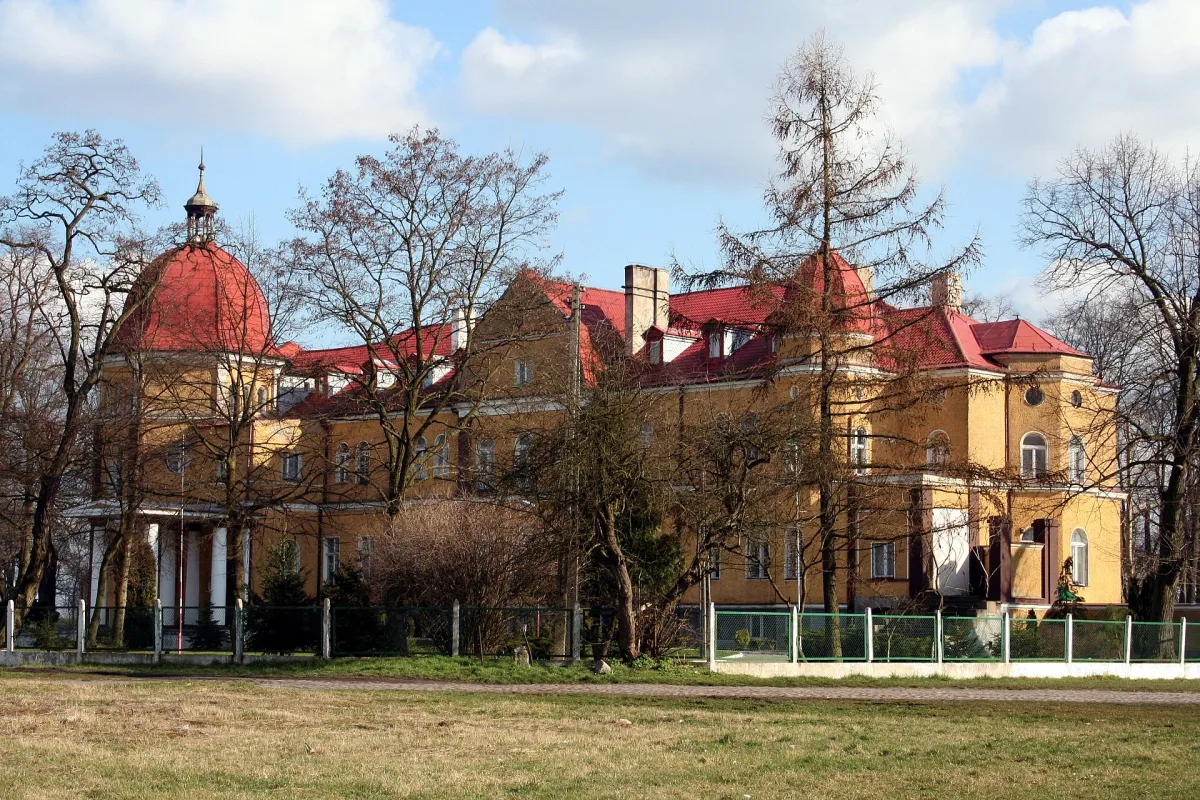
Palace of 1880-1883 on the site of the burned von der Marwitz manor house, with stucco work in the former ballroom and a historic park, today the seat of an institution for young people.
Smolnica Palace is a Neoclassical residence with neo-Baroque elements, built in 1880-1883 after a fire destroyed the earlier manor house. It stands next to the village church in Dębno municipality. The building was entered in the heritage register in 2008 because of its preserved original form, the composition of its façades and elements of its interior fittings. Today an educational institution operates in it, so it is a building to be viewed from the outside.
The manor house was built in 1766 by Albrecht Bernd Ludwig von der Marwitz. In 1819 the estate was sold to the banker Aron Meyer-Kornecker, then changed owners until in 1832 it passed to Wilhelm Friedrich von Sydow. His son Wilhelm Karl Friedrich moved to Smolnica in 1857 and in 1866 thoroughly rebuilt the manor house.
The manor house burned down completely on 1 December 1879. The new palace was built in 1880-1883. It was plastered white and surrounded by ponds. On the northern façade a banner with a cross and the inscription In hoc signo vinces was placed, and beneath it the monogram W.v.S. with the motto "Through thistles and thorns", beside the coats of arms of the von Sydow and von der Osten families.
The palace has two storeys, with a partly usable attic. The centres of the longer façades are emphasised by three-storey false projections with gables. At the gable façades stand projections on rectangular, three-sided and polygonal plans, and two staircases in the form of towers, set on an octagon and a circle. Among the most valuable elements of the decoration is the stucco decoration of the former ballroom on the ground floor.
The former furnishings included black oak furniture, a wardrobe from the 16th century, Chinese porcelain, Delft faience and paintings by Flemish and Dutch painters. After 1945 the rest of the furnishings was destroyed, and the palace served first as quarters for Soviet troops.
The palace park was laid out in the 19th century on 5.3 hectares. It contains 27 species of deciduous trees, 9 of conifers and 24 species of shrubs and climbers, mainly maples, limes, oaks, ashes, horse chestnuts and hornbeams, with an estimated age of 150-250 years. The park was entered in the heritage register in 1977 (no. 377).
After the war the palace was taken over by the state: repatriates lived here, in the 1950s there was a holiday camp for the children of miners from Silesia, from 1956 the offices of a state farm (PGR), and from 1965 an agricultural school. According to the entry on the village, it now houses the Youth Sociotherapy Centre.

Be the first! Add a comment.
You need to log in to add a comment.
Log in