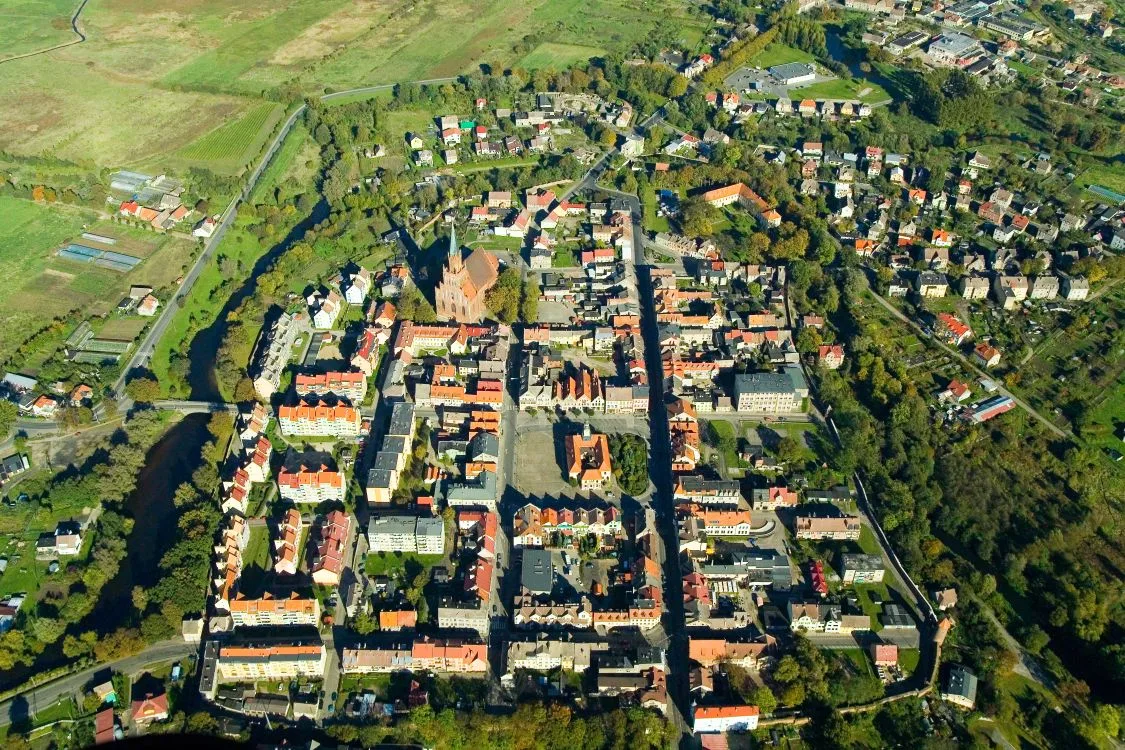
Historic Old Town of Trzebiatów on the Rega: charter of 1277, regular chessboard layout, market square, defensive walls of the 13th and 14th centuries, entered in the register in 1955.
The Old Town in Trzebiatów is a spatial layout entered in the heritage register, in which historical forms from the Middle Ages to the early 20th century predominate. The town lies on the Rega, and its historic centre has, as the description of the layout assesses, more than local value. It was entered in the register in 1955, within the boundaries of the former defensive walls.
The first mentions of the fortified stronghold of Tribetov date from 1180. The stronghold stood on a rise in a bend of the Rega, and a craft and market settlement developed beside it. In 1277 Duke Barnim I of Pomerania granted it town rights based on German law, and in 1281 the rights were confirmed under modified Lübeck law. The Rega was an important waterway, and a land road linking Kołobrzeg with Szczecin, Stargard and Gryfice ran through the town.
The town received a regular chessboard layout with narrow, deep plots built up with tenement houses set with their gables to the street. Two blocks were set aside for the town hall and the church, and a third was taken by the castle. The market square, measuring 94 by 104 metres, was shifted from the centre of the layout towards the south-west. Today on this plan stand, among others, the town hall and the Church of the Motherhood of the Blessed Virgin Mary.
In 1299-1337 the town was surrounded with walls of stone and brick. At first two gates led into it, the Gryfice and Kołobrzeg gates, and in time the Łaziebna and Żeglarska gates were also mentioned. In the panorama of 1618, beside the mass of the parish church, the town gates and the Kaszana Tower dominate. In the 18th century the moats and fortifications began to be removed and turned into gardens. Among the important buildings of the old town were also mentioned a palace, chapels and the hospitals of the Holy Spirit, St George and St Gertrude, mills and a mint.
In 1945 part of the buildings in the town centre were destroyed, but all the more important public buildings and the town walls survived. More serious losses were brought by neglect and demolitions in the post-war years. In 1967 infill development began to be built, but it was carried out for only five buildings, and new housing development of the 1970s damaged the historic structure. Later systematic revalorisation work was undertaken, and in 1996 the town was included in the programme "Saving Historic Small Towns".

Be the first! Add a comment.
You need to log in to add a comment.
Log in