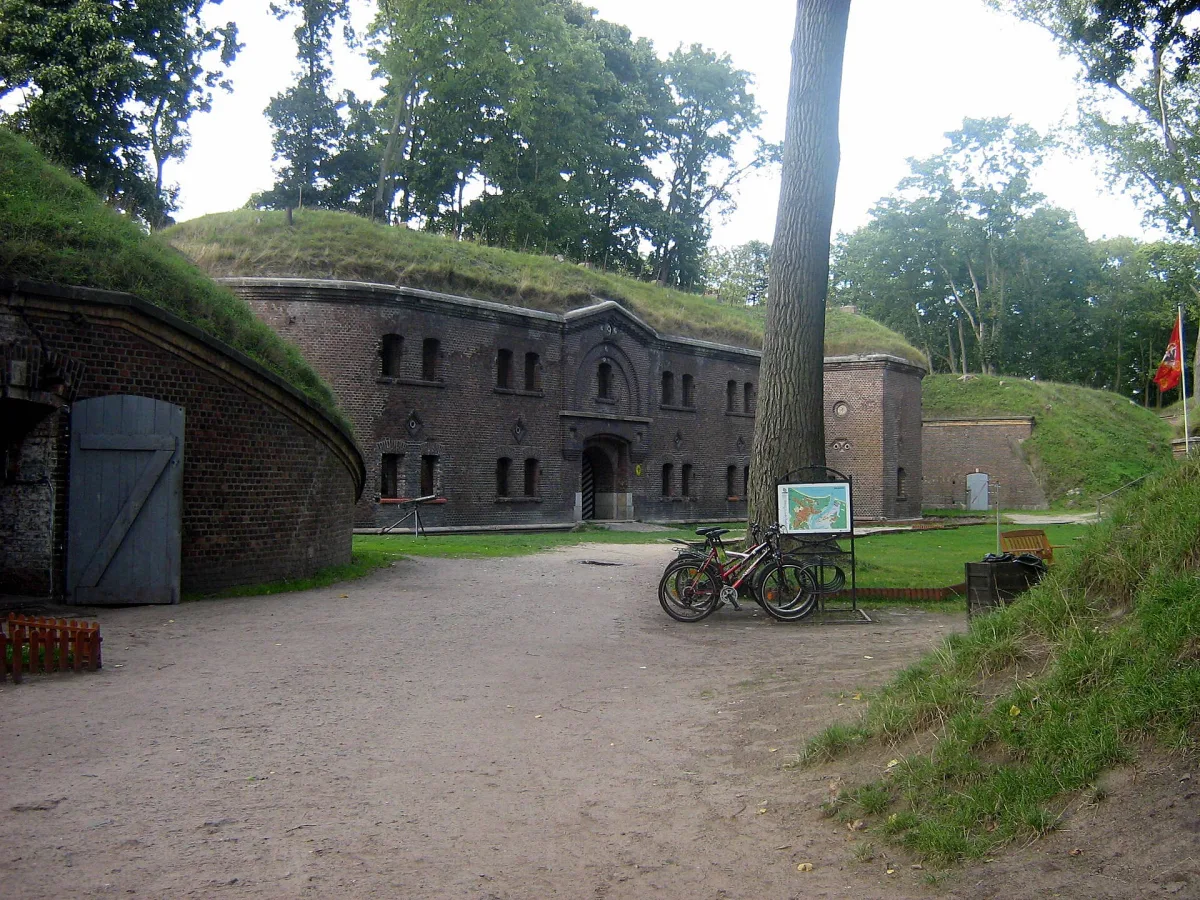
A Prussian coastal fort of 1848-1859 with a museum and visits in the role of a recruit, reached today by ship.
Gerhard Fort, also called the Eastern Fort, is one of the best preserved Prussian coastal artillery forts in Europe. It stands in the eastern part of Świnoujście, on Wolin island, near the lighthouse, and a museum is housed in its redoubt. Access today is unusual: you travel to the fort by ship.
The reason for building the forts in Świnoujście was an incident in 1848, when a Danish frigate blocked the Świna for several months. The Prussian authorities decided to build a naval fortress, and the Eastern Fort was built in 1848-1859 to defend the port and the Świna strait against an enemy fleet. The name commemorates Gerhard Cornelius de Walrawe, a 17th-century designer of Prussian fortresses who prepared the preliminary plans for the port of Świnoujście.
The fort was built on a pentagonal plan, with earth ramparts with artillery positions and a two-storey redoubt in the gorge. The redoubt had 25 12-pounder guns in casemates.
In 1876-1877 the fort was rebuilt with money from the war indemnity received from France. The course of the moat was changed, new ramparts were raised, and 11 artillery positions were built on them, on which 4 Krupp coastal guns of 15 cm calibre and 7 guns of 21 cm calibre were mounted. According to the Wikipedia entry, these positions form one of the best preserved artillery benches in Europe, with relics of various types of gun mountings. The redoubt lost its armament and became barracks: on the sea side it was banked with earth, and the loopholes on the courtyard side were turned into windows.
At the beginning of the 20th century electricity and a telegraph line were brought to the fort. After the First World War the fort was partly disarmed and handed over to the German navy, and after the Second World War it was used by the Soviet army. In 1962 it passed to the town, then for several years it served as a warehouse, and then it was abandoned.
According to the fort's website, in the first half of 2001 the fort was leased by history enthusiasts, and it was officially opened to tourists on 11 August 2001. The Wikipedia entry gives the year 2011. Since 2004 the fort has been the seat of a reenactment group of the 34th Fusilier Regiment of Queen Victoria of Sweden, and since 2010 the Coastal Defence Museum has been housed here.
The visit takes the form of an accelerated military training: tourists walk with a guide in uniform, learn the history of the fort and go through several trials, including drill and firing a cannon. The training lasts about 75 minutes. In the season a guide sets off on the route about every 30 minutes, and out of season the fort is visited individually with plan-guides. Organised groups can book a time.
The Coastal Defence Museum, according to the fort's website the largest private institution of this kind in Poland, presents a collection of uniforms, cannons, an armoury, documents and soldiers' equipment from the history of the Świnoujście Fortress. According to the fort's website the collection numbers nearly 2000 exhibits, while Wikipedia speaks of more than 3000 in five exhibitions, from artillery to weapons of the Kalashnikov system. On the drill square stands the wreck of an Sd.Kfz. 7/2 half-track, pulled out of the sea near Dziwnów in 2006.

Be the first! Add a comment.
You need to log in to add a comment.
Log in