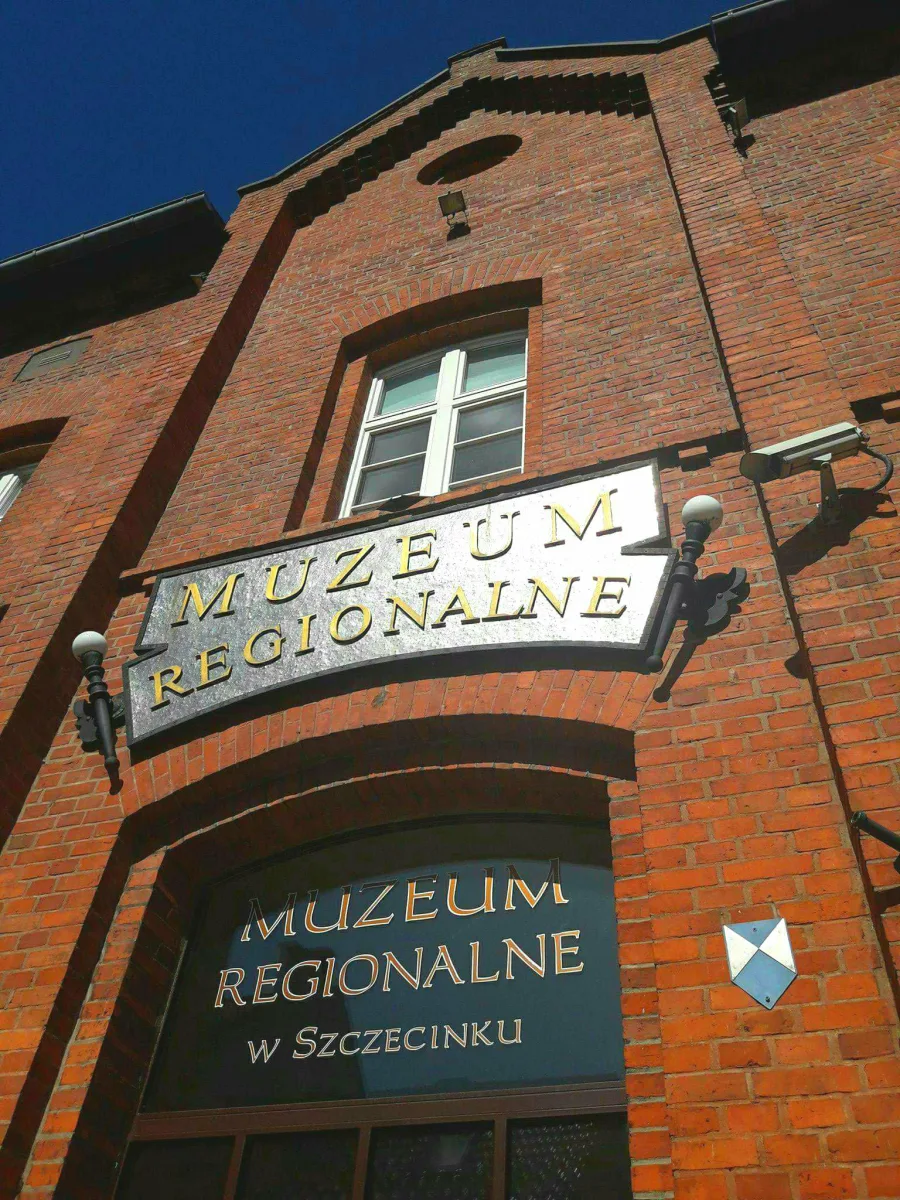
One of the oldest museums in West Pomerania, with regional, nobility, garrison, hunting and silver rooms and archaeological collections.
The Regional Museum in Szczecinek is one of the oldest museums in West Pomerania. The museum's website gives the year of foundation as 1914, while the Wikipedia entry traces its origins to an archaeological exhibition organised in 1866 by the Prussian major F. W. Kasiski.
Kasiski's exhibition comprised more than 700 objects from his excavations of the 1860s in what are now the Człuchów and Szczecinek counties. The collection was taken to Berlin, where it gave rise to the Ethnological Museum in Dahlem. For the celebrations of the 600th anniversary of Szczecinek in 1910 works on the history of the town were produced, and in the autumn of 1913 the mayor appointed a Museum Society. Thanks to it, the museum was organised in June 1914 in the tower of the former St Nicholas' Church (the Tower of St Nicholas' Church). The outbreak of the First World War made operation impossible, and in 1935 the collections were moved to the castle in Szczecinek.
In February 1945, after the Red Army entered, part of the collection was thrown out of a window; some objects were saved by the Sisters of the Immaculate Conception. After the war the museum was revived, in 1947 it took over the St Nicholas tower as a temporary seat, and in 1958 the Szczecinek Land Museum was opened. Today the institution is located at Szkolna 1. The heritage register lists at this address a brick building in the eclectic style from 1879-1880, which was originally a school.
The regional room shows the history of the town and the region from the Middle Ages to the present: painting, sculpture, and products of blacksmiths, goldsmiths and pewterers. The nobility room concerns the Pomeranian nobility, among them the families of the Golce of Siemczyno, the Hertzberg of Lotyń and the Podewils of Krąg. The garrison room recalls the troops stationed in the town, and the hunting room presents more than a hundred objects, mainly firearms from the 19th century, and the most valuable items date from the 18th century. In the silver room you will see more than a hundred objects from European goldsmiths' workshops from the 18th to the early 20th century.
The archaeological collections include a stone statue of a Slavic deity, pottery, jewellery and tools. The museum also organises temporary exhibitions, and every May takes part in Museum Night.

Be the first! Add a comment.
You need to log in to add a comment.
Log in