Monuments in Kołobrzeg include Schinkel's neo-Gothic town hall, two medieval towers and traces of the fortress: the Stone Redoubt and the Morast Redoubt.
Six objects spread from the Old Town market square to the mouth of the Parsęta and the belt of dunes on the Baltic. Most of them are defensive architecture, so a route combines a stroll through the centre with a walk towards the sea and the port.
Which monuments in Kołobrzeg to start with?
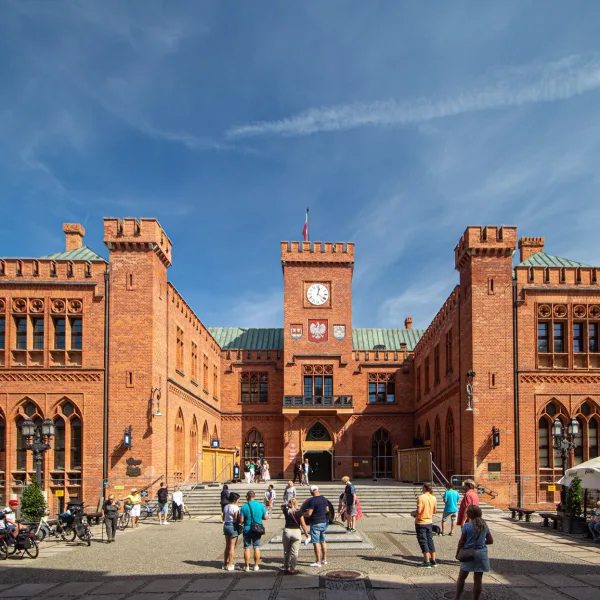
Start with Ratusz w Kołobrzegu (Town Hall), which occupies the centre of the Old Town's main square, beside Ratuszowy Square. From there you can follow the line of the town walls to the two surviving towers.
The town hall is a neo-Gothic structure in pale red brick, designed by Karl Friedrich Schinkel. Construction started in 1829 on the site of the medieval town hall, destroyed in 1807. The town hall's address is Armii Krajowej 12.
Which towers in Kołobrzeg survive from the town walls?
Two survive, both from the 14th century. They differ in condition: one stands complete, the other is a secured ruin.
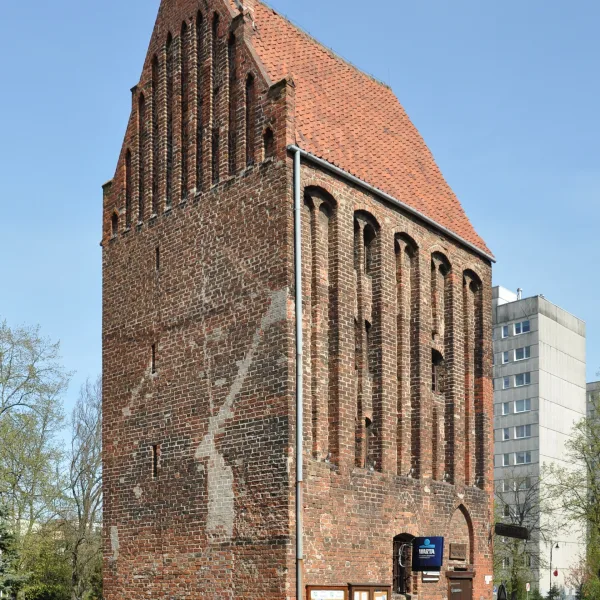
Baszta Lontowa w Kołobrzegu (Match Tower), at Stanisława Dubois 20, is the only fully preserved element of the medieval town walls. It is popularly called the Powder Tower, but according to Wikipedia this is an error arising from a wrong translation of the German name.
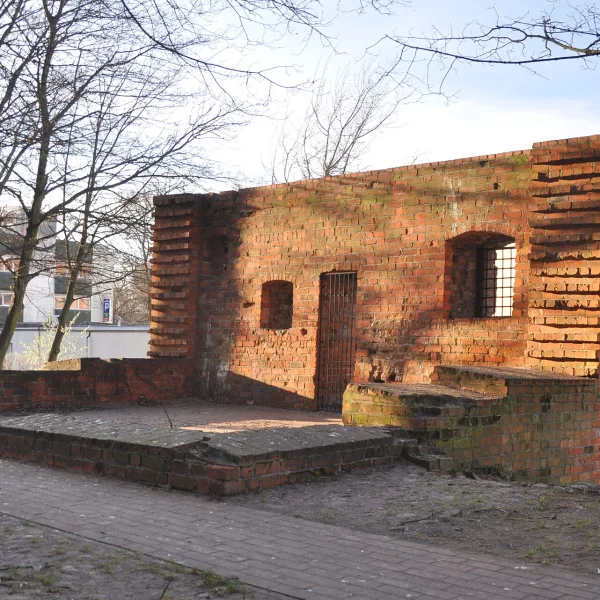
Baszta Więzienna w Kołobrzegu (Prison Tower) belonged to the northern section of the Gothic walls and in the Middle Ages served as a prison for people awaiting trial or the carrying out of a sentence. What remains of the tower building has been secured, so it is a place to look at rather than to enter.
Where in Kołobrzeg to look for what remains of the fortress?
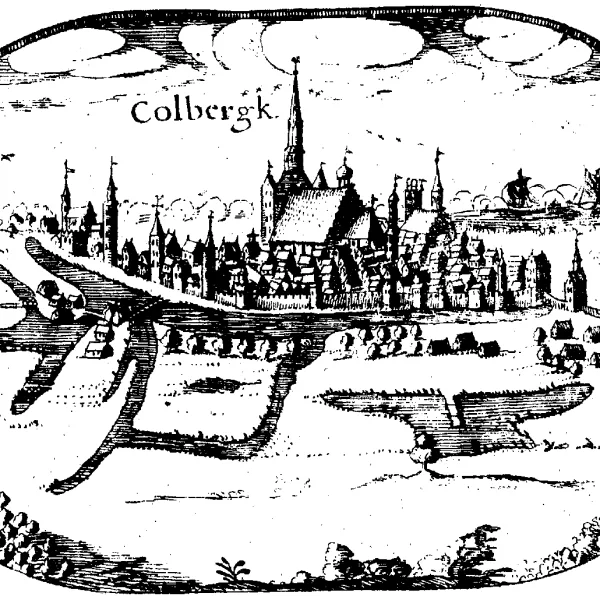
Twierdza Kołobrzeg (Kołobrzeg Fortress) was a modern-era system of fortifications that surrounded the town from 1653. The land fortress was abolished in 1872 and the sea fortress in 1887, but individual forts and redoubts still stand. The town became a fortress once more in 1944-1945. Among the elements that remain are Fort Ujście, the redoubts named Morast and Solna, and the Stone Redoubt.
The Stone Redoubt
Kamienny Szaniec w Kołobrzegu (Stone Redoubt), formerly the Waldenfels Redoubt, was built in 1832-1836. It lies in the belt of dunes right by the Baltic, at the crossing of Fredry Street with Sułkowskiego and Sikorskiego Streets, and closes the Stefan Żeromski spa park from the east. From 1887 it formed part of the recreational grounds of the spa. Today it is a ruin.
Morast Redoubt
Reduta Bagienna (also called Morast Redoubt) is a pentagonal fort from 1770-1774 on the northern tip of Salt Island, at the mouth of the Parsęta. Together with Fort Ujście it guarded the entrance to the port. Today it stands among the yacht marina, so a walk along the quay combines with a look at the fortifications.
A fuller account of the trail is in the article an article on the fortress as it stands today, and the town hall against others in the region is covered by the text on town halls in the eastern part of the region.
How to combine the monuments of Kołobrzeg into one route?
The town hall stands in the Old Town market square, and the towers are what remains of the walls. The Stone Redoubt is by the sea, next to the spa park, and the Morast Redoubt by the yacht marina, in another direction. For the whole list it is worth reserving a longer day.
To mix fortifications with other places, look at museums of Kołobrzeg, churches and monasteries or parks and nature. With children the list For children: Kołobrzeg will help. The whole town is described on the Kołobrzeg page, and monuments across the region are gathered under Monuments.
Frequently asked questions
What defensive monuments are there in Kołobrzeg?
Two medieval towers (the Match Tower and the Prison Tower) and remains of the modern fortress: the Stone Redoubt and the Morast Redoubt.
Who designed the town hall in Kołobrzeg?
Karl Friedrich Schinkel. Construction began in 1829.
Is the Match Tower the same as the Powder Tower?
Yes, that is the popular name, but according to Wikipedia it results from a mistranslation of the German name, so Match Tower is the correct one.
Where is the Stone Redoubt?
In the belt of dunes by the Baltic, at the crossing of Fredry Street with Sułkowskiego and Sikorskiego Streets, on the eastern edge of the spa park.

 Historic sites