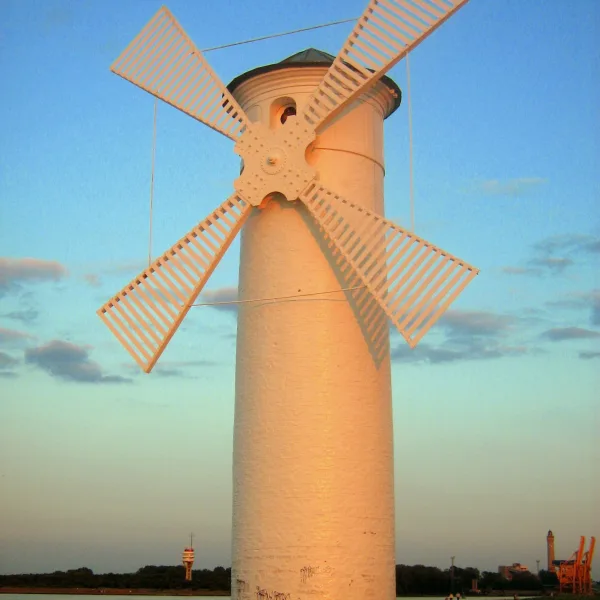
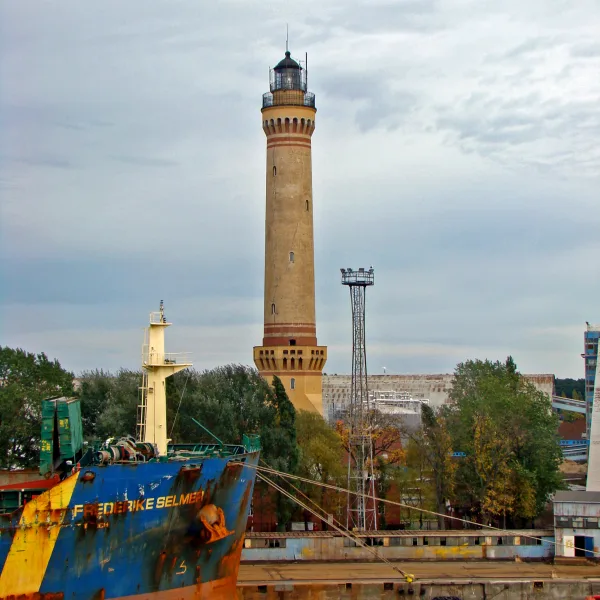
Industrial heritage in Świnoujście: a brick lighthouse of 1857, the Młyny navigation mark on the breakwater and the Piast Bridge across the Stara Świna.
Świnoujście lies on islands, and its industrial heritage here means navigation marks and a crossing that join the shores. The three places suit a walk for two. Other sights in town are on things to do in Świnoujście; similar sites across the region are under industrial heritage in West Pomerania.
Which industrial heritage sites should you see in Świnoujście?
The lighthouse, the Młyny stawa and the Piast Bridge. The first two are navigation marks at the mouth of the Świna, the third is a crossing over the Stara Świna, so each shows a different side of the town's technical heritage.
The Świnoujście Lighthouse rises in Warszów, by Bunkrowa street. Finished in brick in 1857, it measures 67.7 m, has 308 steps, and, says Wikipedia, no other Polish coastal lighthouse is taller. Stawa Młyny is a white, windmill-shaped beacon 10 m tall with a black roof, put up in 1873-1874 where the West Breakwater ends. Over the Stara Świna runs the Piast Bridge in Świnoujście, opened in 2012 and 407 m long, joining Karsibór island with Ognica.
The article The tunnel under the Świna and the crossings between Świnoujście's islands covers other crossings in town.
Frequently asked questions
How tall is the Świnoujście lighthouse, and how many steps lead up?
There are 308 steps in a tower 67.7 m tall, and visitors may go up.
Which parts of town does the Piast Bridge link?
Karsibór island with Ognica on Wolin island. It crosses the Stara Świna near the Piast Canal.

 Lighthouses and ports